Sunday, 23 October 2016

November 2016

Crows.  Wherever you go in the world (except Antarctica!) you are almost certain to see a member of the crow family.  They are mostly large, raucous and black, though that last adjective couldn’t be applied to the jay, one of the more colourful of our native corvids.  (Corvid is the posh name ornithologists use instead of ‘member of the crow family’.)  On a recent trip to Aberdaron in North Wales, I was privileged to see two of the least common members of the crow family – the raven and the chough.  The chough is our rarest crow and there are only about 250 to 350 breeding pairs in the UK.  They are confined to the far west of the country and nest on the west coasts of Wales, Scotland, and Ireland.  In 2002, a small population re-established itself in Cornwall, a former chough stronghold.  Of course, farmers were to blame for their decline and eventual extinction in Cornwall, but in this case not for destroying habitat but for leaving it alone.  Choughs feed mainly on invertebrates, especially ants, and nest on cliffs, and the Cornish farmers stopped allowing their stock to graze around the cliffs where they were difficult to manage and moved them inland.  This allowed scrub to grow up and stopped the choughs getting at the food they were used to.  The RSPB has done a lot of work in Cornwall to restore grazing there and choughs have successfully bred there ever since.
Carrion Crow - Corvus corone corone
The other member of the crow family that I saw in Wales was the raven.  There were three of them enjoying a stiff easterly breeze around a rocky outcrop that I suspect was their nesting site.  It turns out that had I known about it, I wouldn’t have had to travel to Wales to see them because there have been a pair nesting on the East Hill in Hastings this year.  If you are down that way, it is worth looking out for them.  They are bigger than a carrion crow and just as black, so you’ll need to look for the very thick beak and the diamond-shaped tail.  The tail comes to a point in the middle, unlike the crow which has a flat or slightly rounded tail.
Rook - Corvus frugilegus (with a slightly malformed beak)

Jackdaw - Corvus monedula
There is no shortage of members of the crow family around Pett village.  There is at least one noisy rookery (the rook is slightly smaller than a crow with a whitish grey base to its beak), and plenty of jackdaws.  I admit to having a soft spot for jackdaws.  They are a slightly comic bird with their upright stance, swaggering walk and those striking white eyes.  I guess I can identify with the grey head as well.
The more colourful members of the crow family, the magpie and the jay are regularly seen in the village.  Jays are as common as magpies but less often seen as they stay hidden in trees and bushes most of the time.  Late autumn is a good time to see them as they come out to collect acorns which they stash away to eat when the weather gets cold and food gets scarce.
You can’t avoid seeing magpies with their flamboyant metallic blue wings and their boisterous habits.  I was recently told of a magpie with a deformed leg which despite that handicap was getting about and apparently feeding well.  Magpies, along with all other members of the crow family are intelligent and resourceful birds so it stands a good chance of survival.

Recently, nature has suffered a great loss in the death of Trevor Buttle.  His knowledge and cheerful enthusiasm for the natural world will be greatly missed.

Pied Crow. Madagascar
Australian Raven, Australia
It seems that I don't have any other photos of UK corvids - perhaps they are too commonplace, a situation I will have to try and rectify.  Meanwhile here are some from other countries...
Azure-winged Magpie, China (Note this is the same as those you will see in Southern Spain but the jury's out on whether or not they are the same species

Red-billed Magpie, China
Jackdaw - Corvus monedula, Sweden

Saturday, 24 September 2016

October 16

One of our neighbours in the village recently found a bat roosting on their window-frame.  Unfortunately, it was roosting on the inside of the frame.  It’s not clear how it got there, but it’s likely that it chased an insect into an open window and then couldn’t find its way out.  Calling the author of nature notes didn’t resolve the situation as he only took photographs and made sympathetic noises.  Calling Karen Hammond of the Sussex Bat Group was a much better idea as she had the appropriate gloves and knows a lot more about bats.  She captured the bat and identified as a male brown long-eared bat before releasing it away from the house.
Brown long-eared bat - Plecotus auritus
Karen is the Volunteer Manager at Bodiam Castle and deals with all bat-related issues there.  She is also a registered bat-carer.  That last fact is important as all bats are protected species and anybody who handles them must have enough knowledge and an appropriate licence.  (There is also the slight risk that bats can carry a rabies-like virus – hence the gloves.) Karen also gives very interesting talks at Bodiam Castle occasionally and I can highly recommend attending one. 
In spring bats make a roost where the females can give birth and suckle their young until they are weaned.  Unsurprisingly these are called maternity roosts.  Normally, for most bat species, the males are not welcome in these roosts, but in the case of long-eared bats males are tolerated there.  Autumn is the time when bats mate, something that must be accomplished before hibernation, so maybe this lone long-eared bat had other things on its mind.
Bats are remarkable creatures, they are very agile as they dart about catching insects on the wing.  We often see a couple of bats flying round the garden at dusk and it is always a pleasure to watch them swooping about.  Apparently the brown long-eared bat is even more agile than most other species and it can hover and take insects from vegetation.
The long ears (in this case, almost as long as its body) are mainly to help with echolocation, the means by which the bat detects its prey.  It sends out pulses of very high frequency sound which echoes off the insects and tells the bat the direction and distance of the insect.  Possibly as a result of its long ears, the long-eared bat can also hear the lower frequency sounds, which allows it to hear insect movement on leaves and branches etc.
If you find a colony of bats roosting in your house rather than just one confused individual, then it is no good calling out a bat expert as it is illegal to disturb or destroy bat roosts in the UK, or to block access to them.  This is a protection covered by both UK and international laws.  The protection is there because bats are generally in decline due to loss of suitable roosting sites as well as the decline in their insect prey due to intensive farming methods used since the end of the Second World War.
Personally, I’d be delighted to have bats roost in our house and I am considering putting up a bat box to try and attract them.  That may mean that we get fewer moths in the garden, but as long as it’s in a good cause…

Away from bats, and more towards their prey, I found a tiny, beautiful and very unusual insect in the garden recently – an Andromeda Lacebug.  These insects are associated with the shrub Pieris japonica otherwise known as Japanese Andromeda and were introduced into the UK from Asia via the plant trade. 
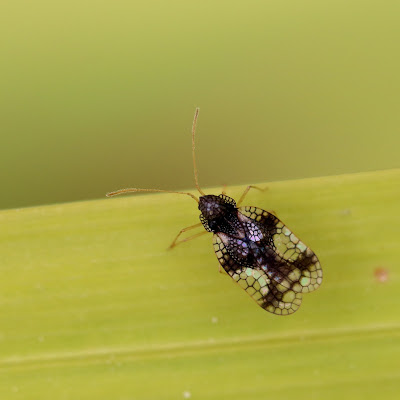
Andromeda Lacebug - Stephanitis takeyai 
For more details about how the bug got its name see www.pettnats.blogspot.com.